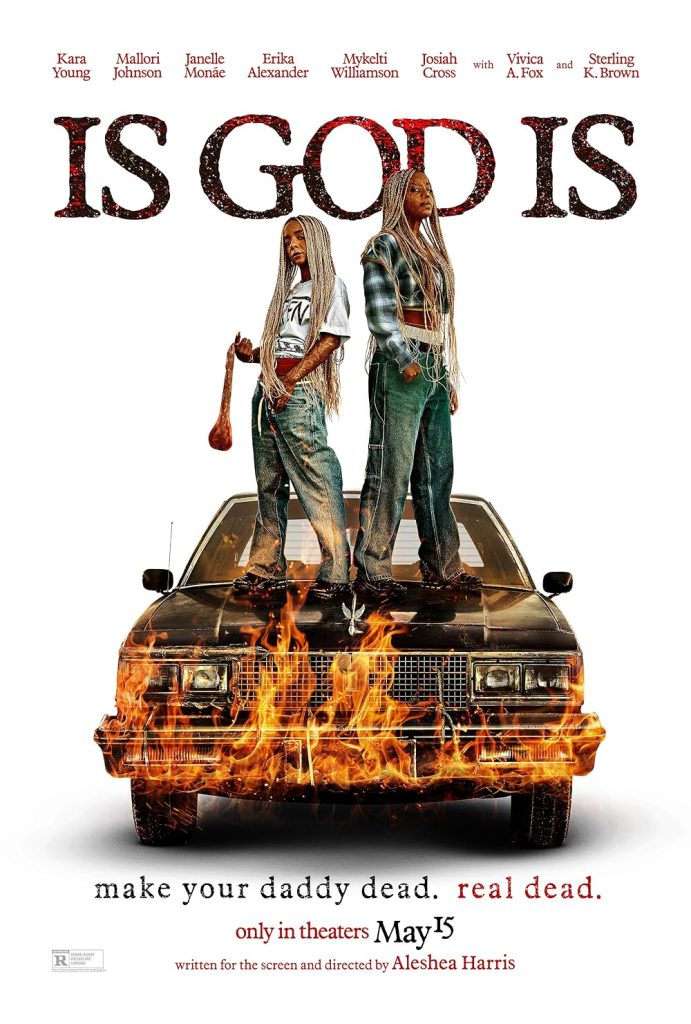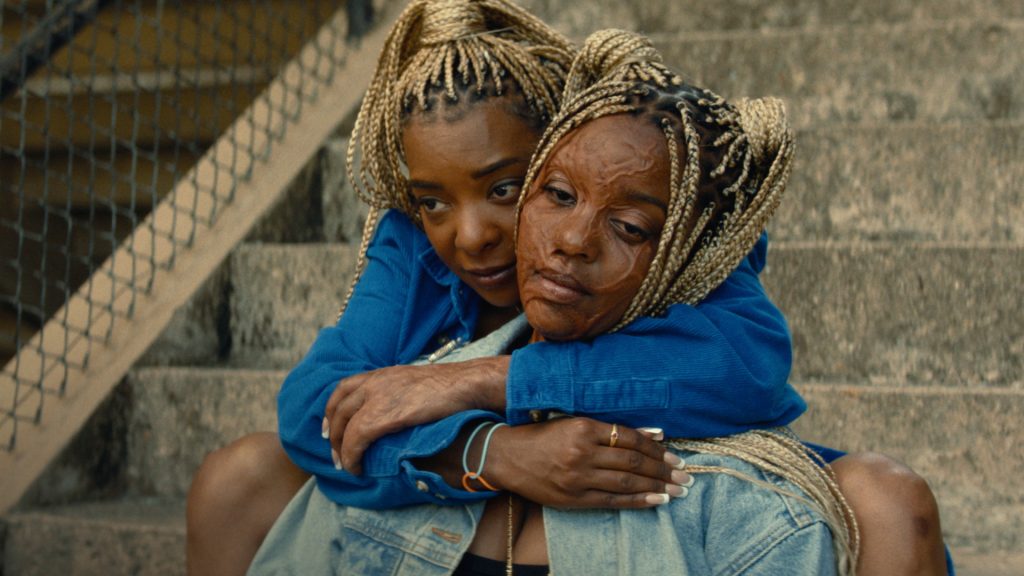
Overview: This is a beautiful, poignant, and brutal story about two Black sisters, Racine the tough one and Anaia the quiet one, who set out to uncover their roots. In doing so, they discover much more about themselves and the boundaries in life.
First Thoughts: IS GOD IS felt as if Precious, The Burning Bed, Thelma & Louise, and Kill Bill all had a baby, and I’m here for it…every violent second. It’s an exquisite revenge film that blends violence, action, grief, and emotional survival into something that feels deeply centered on the Black woman experience from multiple angles at once. What really stayed with me was how the film refuses to reduce its women into archetypes. Honestly, if we made a list of all the relegated stereotypes Black women usually get boxed into onscreen, this movie destroys them one by one because every woman here feels nuanced, specific, and human instead of symbolic or flattened. Even when the film leans into mythic revenge energy, the characters still feel emotionally grounded in ways that kept pulling me in.
Characters/Portrayals: The two sisters are the emotional core of IS God Is, and what makes them work so well is how the film constantly pushes against the archetypes it initially gives them. Racine may be “the Rough One” and Anaia “the Quiet One,” but the movie keeps revealing softness inside one and darkness inside the other. They really yin and yang each other beautifully. Some of the most intimate moments are the quiet rituals between them: massaging scars, soothing burns, running ice over damaged skin. Those scenes communicate love, trauma, survival, and protection without needing much dialogue at all. I also liked how the captions occasionally functioned like a private communication channel between the twins. It was a clever device, even if I personally wished the film had pushed it further during the more traumatic moments, almost turning it into a hidden survival language or emotional lifeline between them instead of just intermittent communication. One of the hardest moments in the film is when the sisters’ scars are finally acknowledged directly and cruelly by the older son. Until then, the shame and humiliation surrounding their trauma mostly sits underneath the surface, so when it’s finally verbalized, it lands brutally.
Vivica A. Fox brings a strange mythic authority to Ruby the God, feeling somewhere between a mob boss and a spiritual figure people must kneel before. Sterling K. Brown is terrifying because he weaponizes warmth and charm, pulling people in before erupting into violence. Erika Alexander adds needed levity and mysticism to the film’s heavier emotional stretches, while Janelle Monáe quietly embodies survival exhaustion as a woman trying to escape before it’s too late. Together, the supporting performances help expand the film’s themes of generational violence, emotional damage, and the lingering aftershocks of abuse without ever pulling focus away from the sisters themselves.
Writing: The writing isn’t quite Southern Gothic, but you can absolutely feel the theater in it. The film leans heavily into dialogue and emotional exchange more than flashy staging, and I liked how every character sounded distinct from one another. Erika Alexander never feels like Vivica A. Fox, Sterling K. Brown never sounds like Janelle Monáe, and even the sisters process the same trauma in completely different ways. Nobody feels copied from the same mold, which gives the film emotional texture even when it drifts into surrealism and mythic revenge territory.
What stayed with me most is how much the writing becomes about the sisters learning to love themselves while realizing they’re still writing their own story. Their emotions constantly shift from curiosity to anger to confusion to fear, and the film understands that family love is rarely simple or emotionally unified just because people share blood. Even Sterling K. Brown’s character is layered in a way that shows how fragile his control really is once the sisters arrive and disrupt the life he built around fear. It reminded me a bit of The Stepfather, where everything appears stable until somebody threatens the illusion holding the family together. The film also quietly suggests that Erika Alexander’s character, while initially somebody you may feel sorry for, may have actually escaped a version of this man simply because he never stayed long enough to trap her in the same cycle of abuse the others experienced.
I also love the fact that all of the men die, but not all of the women do. Most of the women actually survive, which feels intentional in a genre that usually brutalizes women just to motivate somebody else’s revenge story. Here, the women are centered, layered, and allowed to continue existing beyond the violence while nearly every man, including the father and sons, functions as supporting energy orbiting around the sisters’ emotional journey.
Direction: What I appreciated most about Aleshea Harris’ direction is that she fully commits to this being a modern evolution of Grindhouse. You can feel the DNA of those older revenge and exploitation films all throughout it, from the saturated colors to the sweat-drenched closeups to the brutal emotional tension underneath the violence. But instead of centering men on a revenge mission from the start, the film reframes that structure through two Black women who initially aren’t even sure they want revenge at all. Their journey starts from curiosity, not bloodlust, and I think that changes the emotional texture of the entire film. Most Grindhouse stories are built around a singular mission to kill somebody, but IS God Is lets the sisters slowly and thoughtfully decide whether they even want to continue down this road as things become darker and more dangerous.
I also appreciated how restrained Harris is with the trauma. She never tries to force pity onto the audience or reduce the sisters to their scars and abuse. Instead, she simply lets us exist in their world and gradually piece together the layers of what they’ve survived through foster homes, abandonment, violence, and emotional neglect. Even when the film becomes harsh and violent, there’s still thoughtfulness underneath it instead of empty revenge fantasy, and that balance is what really made the directing work for me. Not to mention, it felt genuinely refreshing seeing this many Black women centered in major roles without the film falling into the expected frameworks people usually associate with ensemble Black female casts. Every major emotional force in the story belongs to the women, while the men, including the father and sons, ultimately function as supporting characters orbiting around the sisters’ emotional and psychological journey.
Pacing: The pacing felt perfectly crafted, much like a Western or a revenge quest. Once the sisters began their journey, every character they met had a distinct purpose. The structure was classic: the sisters’ story, then a new piece of the puzzle. From their mother’s mission to encounters with characters like Erika Alexander, Mykelti Williamson, and Janelle Monáe, each encounter had a beginning, middle, and end. Even in quieter moments without new characters, the film returned to the sisters, revealing more layers of their bond. The pacing never lagged. Each road segment deepened their dynamic, and each person they met fit into the larger revenge narrative. The nod to Kill Bill’s structure was clear, especially with Vivica A. Fox’s presence, but I won’t spoil exactly how. Ultimately, every moment felt like a crucial step in the sisters’ evolving story.
Visuals: The visuals stood out with rich saturation, making brown skin feel beautifully varied and alive. The film gave me that same thrill of seeing melanin on screen as something like Queen & Slim, with warm tones, saturated colors, and that raw but polished grindhouse feel. It was almost cinema verité, yet with a 70s technicolor edge. The sisters’ blonde hair popped against the deep brown skin, and I realized the cast was almost entirely Black. It was so refreshing to see a film that didn’t feel the need to throw in anyone for validation. It felt fully authentic, and I loved it for that.
Sound Design/Orchestration/Soundtrack: The soundtrack was raw, grimy, and full of energy, like Black folk music with angst and power. From Beyoncé’s yells to Doechii’s bold anthems, each track felt like a challenge. Whether soft or intense, you stayed gripped and felt the Blackness in every moment.
Final Thoughts…for now: This was a powerful action film with Black female leads, a rare unicorn. I loved it. It gave me that feeling when I watched Queen & Slim, something simple, beautiful, and deeply Black. I would be here for a director’s cut. Whether more fleshing out or more grit, I would be here. Just like they’re making a prequel of Weapons, any character from this journey could have a spinoff. Ms. Harris did a phenomenal job. I see the stage play roots, and I hope for a revival with big actors digging in. It is stunning.
Films that came to mind while watching: Precious, Queen & Slim, The Burning Bed, Kill Bill, Boyz n the Hood, Thelma & Louise, and Nope.
IS GOD IS ★★★★½ (4.5/5)
Directed by: Aleshea Harris
Written by: Aleshea Harris
Starring: Kara Young, Mallori Johnson, Viveca A. Fox, Erika Alexander, Janelle Monae, and Sterling K. Brown
Country: USA
Year: 2026
Production/Distribution: Amazon Studios